Peter Smith
Google's shift toward AI-driven search isn't just talk anymore—it's showing up in real numbers. Recent data reveals that Google Search revenue has climbed steadily over the past five years, while the company's "Search AI Mode" feature has exploded to more than 75 million daily users. The message is clear: AI isn't just an experiment—it's becoming core to how Google does search.
Key Metrics
A recent industry analysis highlighted several major developments.
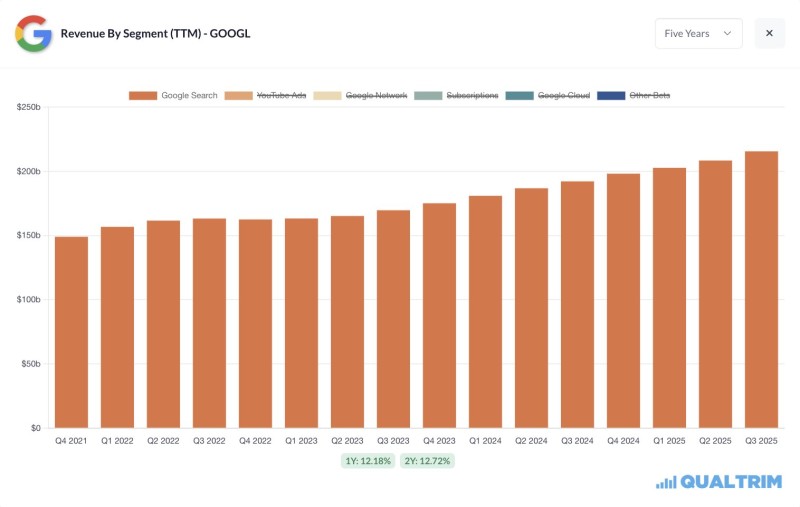
The data paints a picture of both rapid user adoption and sustained financial performance:
- User Adoption: Google's Search AI Mode now serves over 75 million daily active users, making it one of the company's fastest-growing AI features
- Revenue Growth: Search revenue has increased consistently from approximately $150 billion in late 2021 to over $220 billion by mid-2025
- Market Position: Search remains Google's dominant revenue driver, significantly outpacing other segments including Cloud, Subscriptions, and YouTube
- Growth Rate: The business shows stable mid-term expansion with double-digit percentage growth over one and two-year periods
Revenue Trends Show Steady Climb
The growth has notably accelerated from late 2023 through 2025, aligning closely with the rollout of AI enhancements. This timing suggests users and advertisers are responding positively to the new capabilities.
Why Users Are Embracing AI Search
What makes AI Search compelling is straightforward: it handles complex questions better, delivers conversational answers, provides instant summaries from multiple sources, and adapts to what users actually want. These features reduce friction and make search feel more intuitive. Google's massive scale—billions of daily queries—gives it a unique advantage in rolling out AI capabilities compared to smaller competitors.
What This Means for the Industry
The implications are significant across the board. For Google, the data shows AI is strengthening rather than undermining its core business. Advertisers will need to rethink their strategies as AI-generated answers change how users interact with results. And competitors like OpenAI and Perplexity now face an incumbent that can deploy AI features to billions of users instantly.
With 75 million people already using AI-enhanced search daily and revenue continuing to rise, Google is making a statement: AI isn't just an add-on to search anymore. It's quickly becoming the standard experience. The real question now isn't whether AI will reshape search, but how fast Google will complete this transformation.
 Peter Smith