Eseandre Mordi

Grokipedia just hit a major milestone. The AI-reviewed knowledge platform, powered by xAI's Grok, has surpassed 701,974 approved edits — and the number keeps climbing. As X Freeze reported, the platform now hosts over 6,092,140 total articles in its current v0.2 release.
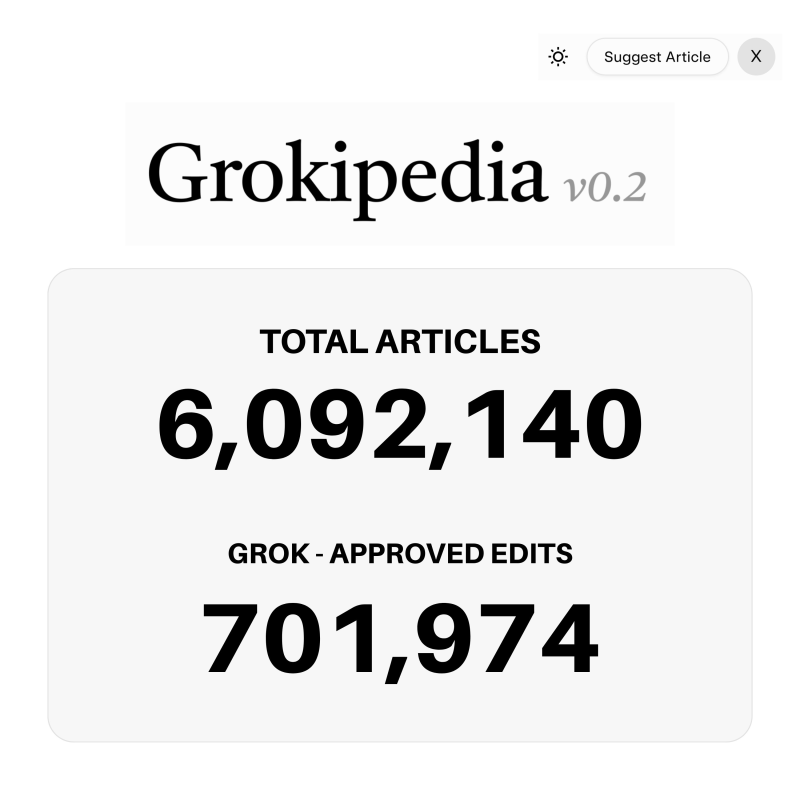
If you've never heard of Grokipedia, here's the short version: it's a living knowledge base where users suggest edits, Grok reviews them, and approved changes go straight into the database. No waiting for a manual review cycle. No outdated pages sitting untouched for months. Just a continuous loop of contribution, verification, and integration.
How Grokipedia's AI-Reviewed Editing System Actually Works
The workflow is refreshingly simple. A user proposes a change. Grok evaluates it. If it passes, the update is added. That's it. The result is a knowledge base that reshapes itself in real time — something traditional encyclopedic platforms have never been able to do at scale.
Users suggest edits, Grok reviews them, and approved updates are added to the database.
The 701,974 approved edits aren't just a vanity metric. They represent a growing community of contributors actively engaging with an AI-moderated system — and a model that proves automated verification can work alongside human input rather than replacing it entirely.
What 6 Million Articles Tells Us About AI-Moderated Knowledge
Crossing six million articles is a signal that Grokipedia isn't a side experiment. It's a serious attempt to build the kind of knowledge infrastructure that keeps pace with the speed of the internet.
Where static databases rely on periodic manual revisions, Grokipedia's architecture is designed for ongoing refinement. Every accepted edit moves the needle. Every rejected one keeps the quality bar intact. The more contributors engage, the sharper the platform gets — and the 701,974 milestone suggests that engagement is accelerating.
For anyone watching where AI fits into the future of knowledge management, Grokipedia is worth paying close attention to. The combination of community input and real-time AI validation isn't just a product feature. It's a new model for how information gets built and maintained — one that traditional encyclopedias are going to struggle to compete with.
 Eseandre Mordi